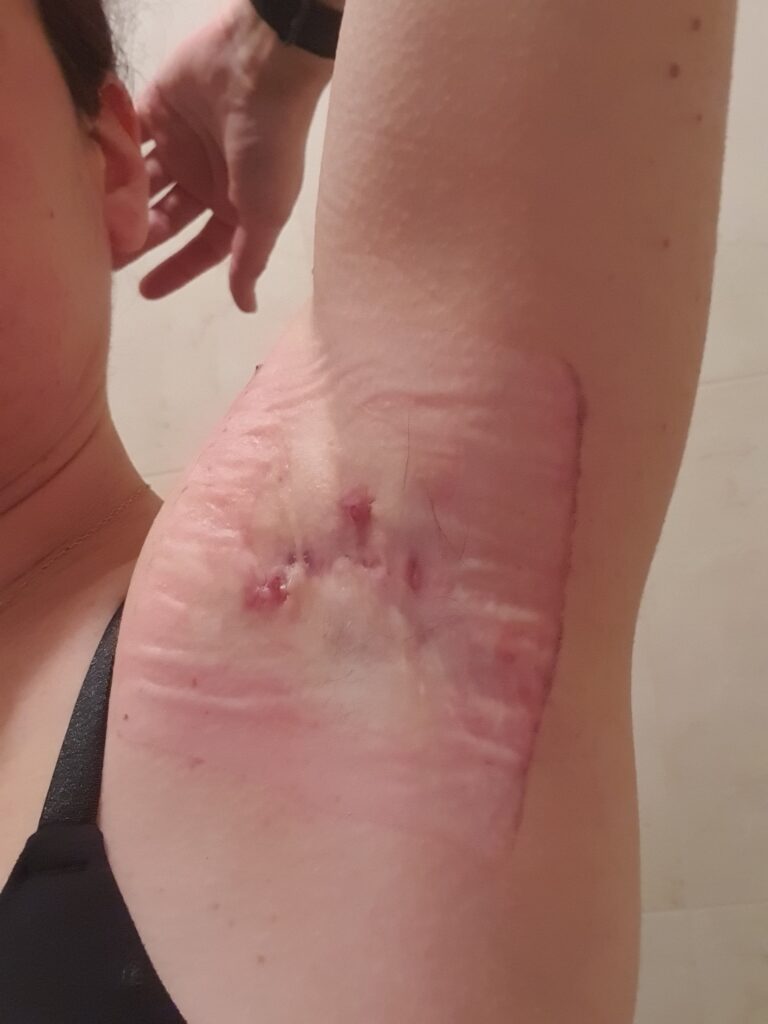
Several factors combine to make Hidradenitis Suppurativa patients especially susceptible to MARSI.
Already compromised skin. HS causes chronic inflammation in the skin. The tissue surrounding an HS wound is rarely healthy; it’s often reddened, swollen, or scarred from previous flares. Adhesives applied to this skin don’t just sit on the surface; they bond with fragile tissue that has very little resilience to repeated trauma.
Frequency of dressing changes. Research suggests HS patients spend an average of eight hours per month on dressing changes, with many changing dressings two to three times daily. Every removal is a potential MARSI event. Over time, that damage accumulates significantly.
Wound location. HS wounds develop in warm, moist, mobile areas: underarms, groin, buttocks, under the breasts. These conditions actually strengthen adhesive bonding, which sounds helpful but isn’t: a stronger bond means more force required to remove the dressing, and more damage to the skin beneath.
Skin that can’t recover. Because HS is a chronic condition, the skin around wounds rarely gets a chance to recover fully between flares. MARSI damage is added on top of existing skin that is already under stress.
MARSI presents in several ways, and it’s not always immediately obvious that an adhesive is the cause. Signs to look out for include:
- Skin stripping: the top layer of skin peels away with the dressing, leaving a raw, weeping area that wasn’t there before.
- Tension injury or blistering: the skin around the dressing edge becomes red, raised, or blistered, particularly if the dressing has been pulled taut during application.
- Contact dermatitis, redness, itching, or a rash in the exact shape of the dressing border, indicating a reaction to the adhesive itself.
- Skin tears, particularly in more fragile skin, removal of a dressing can cause a tear in the skin surface.
- Folliculitis: adhesive blocking hair follicles in hirsute HS wound areas can trigger additional follicular inflammation.
If any of these are appearing regularly after dressing changes, MARSI is a likely cause, and it’s worth discussing with your GP, wound care nurse, or dermatologist.
The good news is that MARSI is largely preventable. There are several approaches that can help, depending on your current wound care routine.
Adhesive removers
Silicone-based adhesive removers dissolve the bond between an adhesive and the skin before removal, significantly reducing the force needed to take a dressing off. Applied around the dressing edge before removal, they can make a real difference for patients who are currently using adhesive products.
Barrier products
Skin barrier films or sprays create a thin protective layer between the skin and the adhesive. They don’t prevent bonding entirely, but they reduce the strength of that bond and provide a buffer for the skin beneath. Particularly useful in areas prone to MARSI or where the surrounding skin is already fragile.
Gentle removal technique
Always remove adhesive dressings slowly, supporting the skin with one hand while peeling the dressing back low and flat, never pulling upward at an angle. While this doesn’t eliminate MARSI risk, it reduces trauma at the point of removal.
Adhesive-free retention systems
The most effective way to prevent MARSI is to eliminate adhesive contact with the skin. This is the principle behind garment-based wound care retention, using specially designed garments to hold dressings in place rather than tape or adhesive borders.
HidraWear garments, crop tops, T-shirts, and boxer briefs, have targeted treatment areas that secure dressings firmly in place without any adhesive touching the skin. Dressings stay put through a full day of movement and activity, and are removed gently without any risk of skin stripping.
For HS patients who change dressings multiple times a day, switching to an adhesive-free system can be genuinely transformative, eliminating one significant source of pain and skin damage from an already demanding daily routine.
MARSI is sometimes dismissed as a minor side effect of wound care. For HS patients, it isn’t.
If you’re experiencing skin damage around your wound dressings, it’s worth raising specifically with your GP, wound care nurse, or dermatologist. Ask about:
- Adhesive-free alternatives to your current dressing system
- Barrier and removal products that can reduce trauma in the short term
- A referral to a Tissue Viability Nurse if wound care is becoming increasingly difficult to manage
You shouldn’t be causing additional skin damage in the process of managing your wounds.
[nectar_btn open_new_tab=”true” size=”medium” button_style=”regular” button_color_2=”Accent-Color” button_color=”Accent-Color” icon_family=”none” text=”Learn about adhesive-free wound care” url=”https://hidrawear.effectordev2.ie/shop/” margin_right=”15″ margin_bottom=”15″][nectar_btn size=”medium” button_style=”see-through” button_color_2=”Accent-Color” button_color=”Accent-Color” icon_family=”none” text=”Next: Wound Care by Body Area →” url=”https://hidrawear.effectordev2.ie/hs-wound-care/wound-care-by-body-area/” margin_right=”15″ margin_bottom=”15″]